return to: Management of Xerostomia (Dry Mouth)
Definitions:
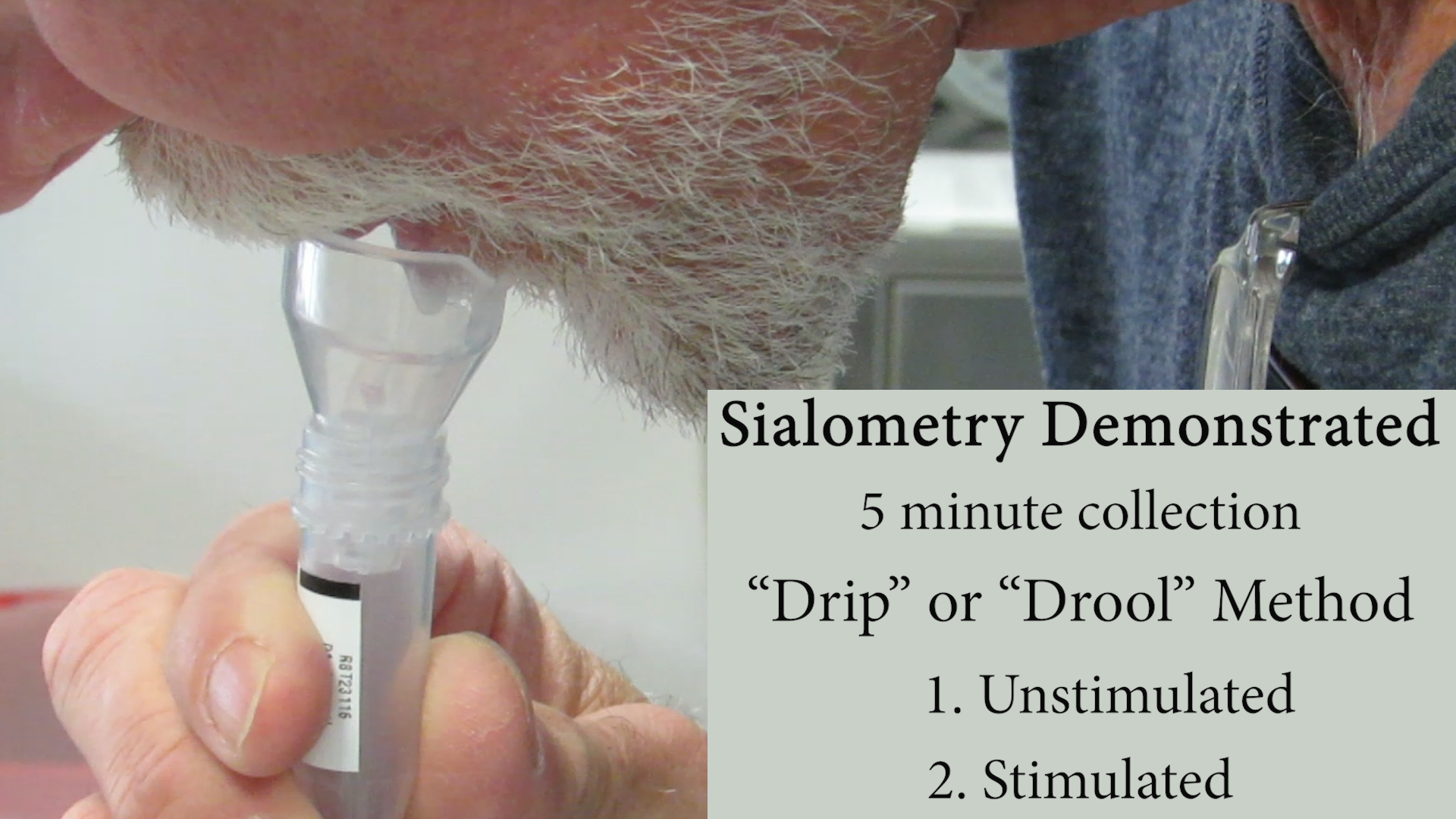
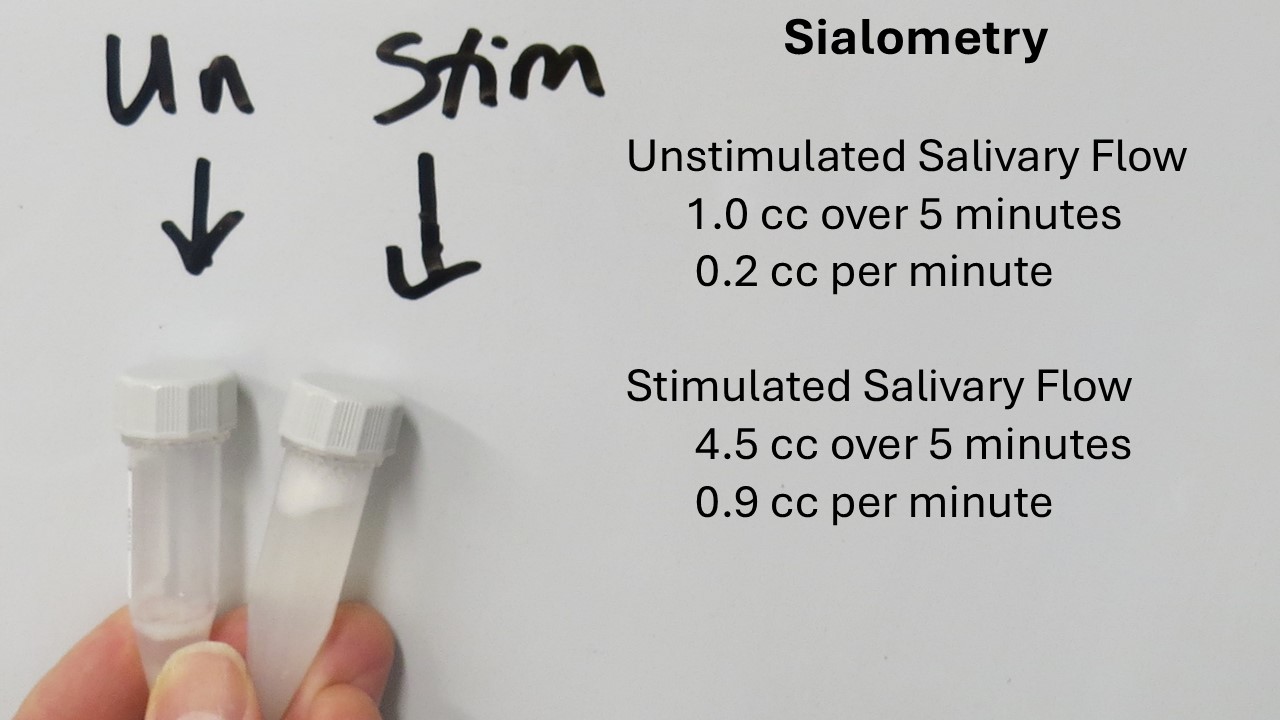
Sialometry: Measurement of salivary flow - various ways to accumulate saliva: Drip/Drool, Spit, Suction Devices: Lashley cups over parotid ducts; Micropipettes over submandibular ducts (Pedersen 1985,Khavandgar 2024)
Sialochemistry: characterizes composition of saliva
Whole saliva: "a complex mix of fluids from major and minor salivary glands and from gingival crevicular fluid, which contains oral bacteria and food debris" (Humphrey 2001)
"Lashley cups": sampling devices placed intraorally directly on Stenson's duct orifice to collect saliva - does not measure whole saliva
Unstimulated salivary flow assessment: without external stimuli
Stimulated salivary flow assessment: mechanical stimulation (paraffin chewing); lemon drop stimulation (Pedersen 1985)
Residual Volume: the small amount (averge 0.8 mL) of saliva remaining in mouth after swallowing (Humphrey 2001)
Background
Proportion of population with dry mouth: 30% (Humphrey 2001)
| Reference | Factors |
| Jain 2023 | Diurnal variationTobacco and areca nut chewing (reduces saliva) |
| Humphrey 2001 | Circannual (yearly) low flow during summer, peak in winter |
Affoo 2015 Vandenberghe Eescampst 2016
| Age (lower salivary flow with increased age) |
| Pedersen 1985 | Circadian, age |
| Wolff 2017 | Medications (comprehensive review by Wolff et al) |
| Reference | Saliva in One Day | Whole Saliva Flow Unstimulated Rate | Whole Saliva Flow Stimulated Rate | |
| Burghartz 2019 | 500 mL/day 96% produced by main salivary glands (parotid/smg/sublingual) | 0.3 to 0.4 mL/min Parotid: 26% Submandibular: 69% Sublingual: 5% | 1.6 to 2.0 mL/min Paroitd: 50% | |
| Humphrey 2001 | 1.0 to 1.5 liters/day | > 0.1mL/min average 0.3mL/min Parotid 20% Submandibular 65% Sublingual 7-8% 300 mL/day | 0.2mL/min contributes 80-90% of daily production | |
| (Humphrey 2001) |
|---|
| Lubrication and protection against irritants |
| Buffering action and clearance |
| Maintenance of tooth integrity |
| Antibacterial activity |
| Taste and digestion |
References
Burghartz M, Hackenberg S, Sittel C, Hagen R. Surgery of the major salivary glands and its impact on salivary flow-A review. Laryngoscope. 2019 Sep;129(9):2053-2058. doi: 10.1002/lary.27587. Epub 2018 Nov 26. PMID: 30478835.
Proctor GB. The physiology of salivary secretion. Periodontol. 2000 2016;70: 11–25.
Mandel ID. Sialochemistry in diseases and clinical situations affecting sali vary glands. Crit Rev Clin Lab Sci 1980;12:321–366.
Jain, Kanu1; Gakhar, Rajnish1; Bhatia, Shagun2; Manjunatha, Bhari Sharanesha3; Jindal, Deepti4; Jindal, Varun5. Comparison of salivary flow rate and pH between healthy subjects and tobacco and areca nut chewers. Journal of Oral and Maxillofacial Pathology 27(3):p 599-600, Jul–Sep 2023. | DOI: 10.4103/jomfp.jomfp_518_22
Humphrey SP, Williamson RT. A review of saliva: normal composition, flow, and function. J Prosthet Dent. 2001 Feb;85(2):162-9. doi: 10.1067/mpr.2001.113778. PMID: 11208206.
Xu F, Laguna L, Sarkar A. Aging-related changes in quantity and quality of saliva: Where do we stand in our understanding? J Texture Stud. 2019 Feb;50(1):27-35. doi: 10.1111/jtxs.12356. Epub 2018 Aug 26. PMID: 30091142.
VANDENBERGHE DESCAMPS, M., LABOURÉ, H., PROT, A., SEPTIER, C., TOURNIER, C., FERON, G., and SULMONT ROSSÉ, C. 2016. Salivary flow decreases in healthy elderly people independently of dental status and drug intake. Journal of Texture Studies 47, 353-360.
AFFOO, R.H., FOLEY, N., GARRICK, R., SIQUEIRA, W.L., and MARTIN, R.E. 2015. Meta analysis of salivary flow rates in young and older adults. Journal of the American Geriatrics Society 63, 2142-2151.
MANDEL, I.D. 1987. The functions of saliva. Journal of Dental Research 66, 623-627.
Pedersen W, Schubert M, Izutsu K, Mersai T, Truelove E. Age-dependent decreases in human submandibular gland flow rates as measured under resting and post-stimulation conditions. J Dent Res. 1985 May;64(5):822-5. doi: 10.1177/00220345850640050801. PMID: 3858303.
Wolff A, Joshi RK, Ekström J, Aframian D, Pedersen AM, Proctor G, Narayana N, Villa A, Sia YW, Aliko A, McGowan R, Kerr AR, Jensen SB, Vissink A, Dawes C. A Guide to Medications Inducing Salivary Gland Dysfunction, Xerostomia, and Subjective Sialorrhea: A Systematic Review Sponsored by the World Workshop on Oral Medicine VI. Drugs R D. 2017 Mar;17(1):1-28. doi: 10.1007/s40268-016-0153-9. PMID: 27853957; PMCID: PMC5318321.
Zohreh Khavandgar, Blake M. Warner & Alan N. Baer (2024) Evaluation and management of dry mouth and its complications in rheumatology practice, Expert Review of Clinical Immunology, 20:1, 1-19, DOI: 10.1080/1744666X.2023.2268283 http://To link to this article: https://doi.org/10.1080/1744666X.2023.2268283