content created June 2026 by Abigail Townsend, BS, Edward Tannenbaum, BS, Bruno Albuquerque Sousa, MD, MSc, FACS and Joan Maley MD
"... although HU analysis provides an accessible and widely available quantitative imaging biomarker, attenuation measurements are influenced by physiologic and technical factors, including age, body mass index, scanner parameters, contrast administration, and partial volume effects. Therefore, quantitative measurements should be interpreted cautiously and integrated with the overall imaging appearance and clinical context rather than relying on a single numerical threshold."
(above conclusion selected from detailed discussion below)
Definitions
The Hounsfield unit (HU) is a measurement of radiodensity used in Computed Tomography (CT) images. This produces a grayscale image that represents a CT reconstruction of the absorption/attenuation coefficient of the radiation within a tissue. The tissue density is proportional to the absorption/attenuation of the x-ray beam. The HU is calculated based on a linear transformation to x-ray attenuation coefficients
Water = 0 HU
Air = negative 1000 HU (-1000 HU)
Cortical Bone = positive 1000 HU (+1000 HU) (DenOtter 2023).
Fat measures approximately at values below –50 HU
Most soft tissue ranging from 20-60 HU (Neeland 2021)
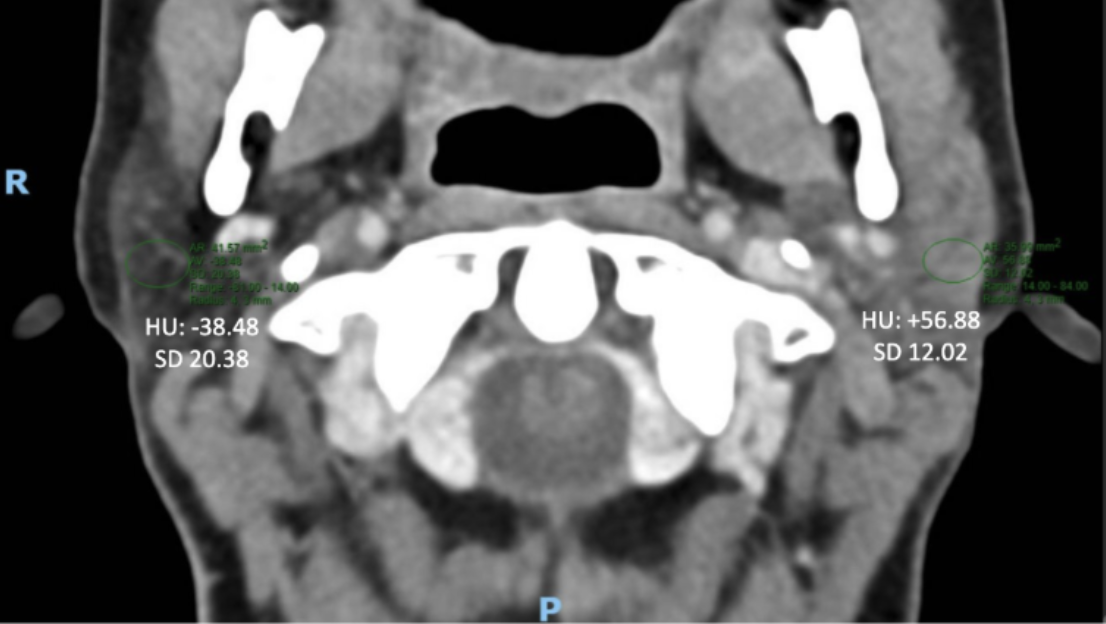
Figure 1. Axial non-contrast CT image of the parotid glands in a female patient demonstrating asymmetric fatty infiltration.
In imaging studies, Hounsfield Unit Assessment refers to:
The quantitative measurement of tissue attenuation on CT images by placing a region of interest (ROI) within a structure and recording its mean HU value. The HU histogram shows the distribution of HU values from various tissues in the region of interest, while the mean HU value shows a single representative value from all tissues (Ryoo 2021).
The Mathematical Definition of HU value is calculated as:
HU= 1000 × μmaterial − μwater / μwater
where μmaterial = linear attenuation coefficient of the tissue/material and μwater = linear attenuation coefficient of water. This formulation makes HU a normalized measure of CT attenuation rather than a direct measure of physical density.
Background
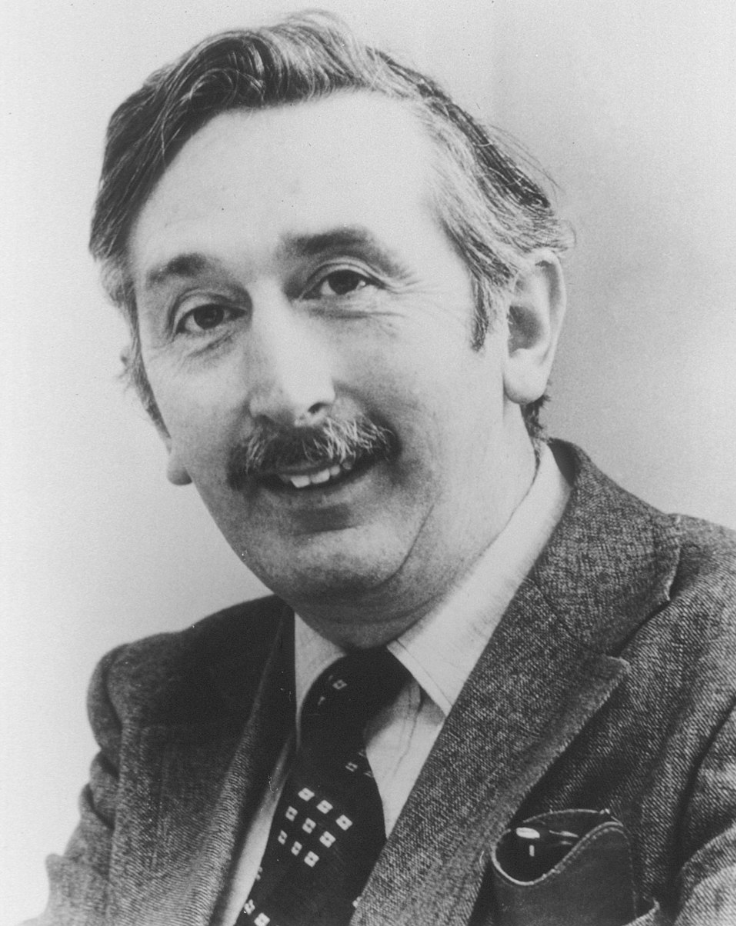
1975 Nobel Prize Award Winner - Godfrey N. Hounsfield (wiki commons)
Godfrey Hounsfield developed the CT imaging scale, defined in HU, and helped establish what is now known as modern diagnostic radiology. In 1979, he was awarded the Nobel Prize for his invention. As a biomedical engineer, he changed the entire face of medical science. Before CT imaging, physicians could not visualize internal structures without performing invasive procedures. The invention of CT enabled clinicians to obtain internal images and make more accurate diagnoses without invasive procedures. Additionally, CT has helped with therapeutic inventions as it can be used to improve treatment planning and monitor disease progression.
Following his service in the Royal Air Force, he learned the basics of electronics and radar science, and after the war, received a diploma from the Faraday House Electrical Engineering College in London. In the 1950’s, he found an interest in computer design and led a group of engineers to create the first solid-state (transistor) computer in England. Additionally, at that time, he noticed some limitations of conventional X-ray, including its ability to visualize bones but not soft tissue. He then began working on developing a computer capable of calculating X-ray absorption patterns for different types of tissues (Shampo 1996).
Within a few years, he designed a CT scanner, served as an experimental participant, and, afterward, CT scanning was introduced into medical practice in 1971. He continued to improve the device to reduce radiation exposure, sharpen images, and develop larger models capable of imaging other parts of the body, which led to the head scanner coming into practice in 1972 and the body scanner in 1975. The CT scan proved to be a highly useful diagnostic tool. This invention represents a significant advance in diagnosing structural lesions in the brain and replaces more aggressive, invasive procedures for visualizing cerebral pathology. After the development of the CT scanner, Hounsfield worked on the next steps in diagnostic radiology, namely nuclear magnetic imaging and what is now termed magnetic resonance imaging.
Hounsfield is commemorated for the scale named after him, used to evaluate CT scans (Bhattacharyya 2016).
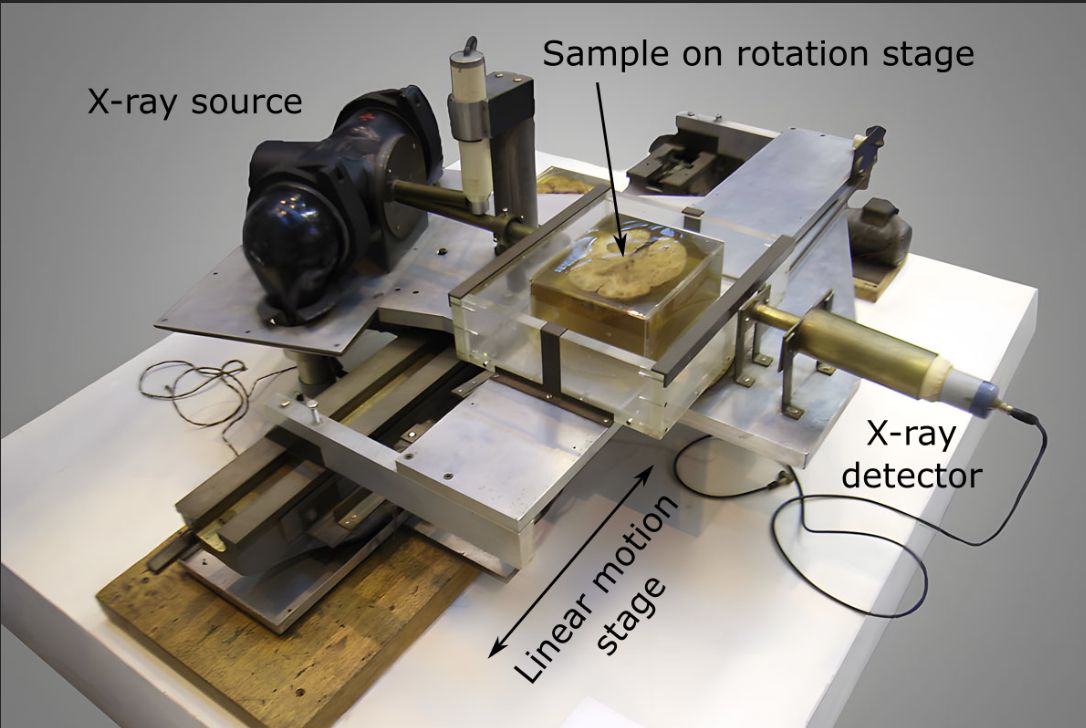
The first CT scanner prototype developed by Godfrey Hounsfield in 1968 - (wiki commons)
Investigation Strategies and Recent Research
One of the earliest uses of Hounsfield Unit analysis was for the use of CT attenuation values for in vivo tissue characterization. Beyond allowing visual interpretation, CT was also important for providing quantitative information, allowing tissues to be distinguished based on attenuation properties. This then led to the investigation of quantifying muscle density, disease-related changes, and tissue composition.
Analysis of HU may provide insight into underlying pathology. In an early study, Ida and Honda reported mean CT attenuation values (± standard deviation) of –10 ± 24 HU for the parotid glands and 41 ± 15 HU for the submandibular glands, highlighting intrinsic differences in gland composition (Ida and Honda, 1989). Alterations in gland attenuation have since been associated with a variety of salivary disorders.
For example, sialosis, a non-inflammatory and non-neoplastic enlargement of the salivary glands, is characterized by fatty infiltration and reduced CT attenuation. In a recent sialographic CT study, glands with sialosis demonstrated a median attenuation of –36 HU compared with +30 HU in normal glands. Characteristic sialographic findings, including ductal curvature, splaying, and truncation, correlated with the degree of fatty infiltration observed on CT (Wenzel et al., 2025).
Similarly, in Sjögren syndrome, a chronic autoimmune disorder characterized by lymphocytic infiltration and progressive destruction of the exocrine glands, CT frequently demonstrates parenchymal heterogeneity and diffuse fatty replacement. Quantitative attenuation analysis has shown promising diagnostic performance, with reported area under the receiver operating characteristic curve values ranging from 0.887 to 0.908 for the diagnosis of Sjögren syndrome (Sun et al., 2012).
CT assessment of cervical muscle fatty infiltration has become clinically important in head and neck cancer. The C3 vertebral level has emerged as a primary cervical landmark for skeletal muscle mass quantification (Zare 2026). Sarcopenia is a key prognostic factor in head and neck squamous cell carcinoma (HNSCC), commonly assessed using the skeletal muscle index (SMI) derived from cervical muscle segmentation. However, manual segmentation is time-consuming, variable between observers, and difficult to scale for routine clinical use. Researchers created an AI system that can automatically measure neck muscle mass on CT scans using SMI at the level of the third cervical vertebra. The system can accurately identify patients with sarcopenia, and sarcopenia status was significantly associated with reduced overall survival and increased feeding tube dependency. These findings highlight the prognostic value of CT-derived muscle mass assessment and support the incorporation of body composition analysis into routine risk stratification and clinical decision-making for patients with HNSCC (Ye 2023).
One of the most active areas of modern research is opportunistic CT screening. HU measurements that are obtained from CT scans performed for unrelated clinical indications can be used to identify previously unrecognized diseases. From a patient perspective, this approach would require no additional imaging time or radiation exposure and would shift the focus from reactive to preventive medicine. Additionally, routine head and neck CT of the paraspinal muscle area at C3/C5 and total cross-sectional area at the submandibular level correlate strongly with established abdominal CT body composition measures and bioelectrical impedance analysis, a noninvasive method used to estimate body composition (Zopfs 2022).
Dual-energy CT (DECT) offers several advantages for head and neck fatty infiltration assessment. Dual-energy CT provides insights into the material properties of the tissues and can differentiate between tissues that have similar attenuation on conventional, single energy CT imaging. DECT material decomposition can quantify fat fraction and enables virtual monoenergetic reconstructions for metal artifact reduction and material characterization beyond conventional single-energy CT (Ginat 2016). The DECT non-contrast images can subtract iodine from contrast-enhanced scans, potentially enabling fat quantification from post-contract acquisitions (Molwitz 2021).
Shortcomings of the concept of ‘fatty infiltration identified.’
Several inherent limitations affect CT-based assessment of fatty infiltration. Although Hounsfield unit (HU) analysis provides an objective and widely available quantitative imaging biomarker, substantial physiologic variability exists among individuals. Prior studies have demonstrated that normal parotid fat fraction increases with age and body mass index (BMI), with older and overweight individuals exhibiting greater baseline fatty replacement than younger or underweight populations. Consequently, establishing a universal HU threshold for pathologic fatty infiltration remains challenging, and demographic factors such as age and BMI should be considered when interpreting low attenuation values (Lee 2023).
In addition to physiologic variability, several technical and conceptual factors influence the radiologic assessment of fatty infiltration. Attenuation measurements are dependent on scanner characteristics and acquisition parameters. Intrascanner differences ranging from 7 to 56 HU have been reported according to scanner energy and material composition, while changes in tube voltage (kVp) may produce attenuation shifts of up to 79 HU within the same scanner platform (Sande 2010). More recently, studies of CT-based body composition analysis have further demonstrated the influence of acquisition parameters on quantitative measurements, underscoring the challenges associated with applying scanner-independent HU thresholds across institutions (Yoo et al. 2025).
Intravenous (IV) contrast administration represents an additional source of variability. Iodinated contrast increases x-ray attenuation in a tissue-dependent manner, with enhancement influenced by vascularity, perfusion, and the timing of image acquisition. Therefore, attenuation values obtained during arterial, venous, and delayed phases may differ substantially, limiting direct comparison between contrast-enhanced and non-enhanced examinations and reducing the reproducibility of absolute HU thresholds (Derstine et al. 2022). Recent advances in dual-energy CT and material decomposition techniques have demonstrated improved tissue characterization and fat quantification, potentially mitigating some of the limitations inherent to conventional single-energy CT (Molwitz et al. 2021; Erley et al. 2024).
Partial volume averaging represents another inherent limitation of CT attenuation analysis. Many anatomical structures contain varying proportions of adipose tissue, functional parenchyma, vascular structures, ducts, connective tissue, and lymphoid elements. Consequently, region-of-interest measurements represent the average attenuation of multiple tissue components rather than that of a homogeneous compartment. Depending on ROI placement and size, this effect may obscure focal abnormalities or lead to overestimation or underestimation of diffuse tissue alterations (Engelke et al. 2018).
Taken together, these considerations indicate that although HU analysis provides an accessible and widely available quantitative imaging biomarker, attenuation measurements are influenced by physiologic and technical factors, including age, body mass index, scanner parameters, contrast administration, and partial volume effects. Therefore, quantitative measurements should be interpreted cautiously and integrated with the overall imaging appearance and clinical context rather than relying on a single numerical threshold. This concept is consistent with the growing role of quantitative imaging biomarkers and opportunistic CT assessment in contemporary radiology (Pickhardt et al. 2022).
Future Directions
Advances in imaging analysis may improve characterization of tissue beyond simple mean attenuation measurements. Radiomics, automated segmentation, and machine learning approaches could capture spatial heterogeneity that is not reflected by a single HU value.
Combining CT-based measures with ultrasound elastography may also be particularly informative. Whereas CT provides insight into tissue composition, elastography assesses mechanical properties. Integration of these modalities may allow investigators to better characterize the spectrum of tissue remodeling and identify imaging biomarkers relevant to function and disease.
References
Ariji, Y., Ariji, E., Araki, K., Nakamura, S., & Kanda, S. (1994). Studies on the quantitative computed tomography of normal parotid and submandibular salivary glands. Dentomaxillofacial Radiology, 23(1), 29–32. https://doi.org/10.1259/dmfr.23.1.8181656
Bhattacharyya, K. B. (2016). Godfrey Newbold Hounsfield (1919–2004): The man who revolutionized neuroimaging. Annals of Indian Academy of Neurology, 19(4), 448–450. https://doi.org/10.4103/0972-2327.194414
DenOtter, T. D., & Schubert, J. (2023). Hounsfield unit. In StatPearls. StatPearls Publishing. https://www.ncbi.nlm.nih.gov/books/NBK547721/
Derstine, B. A., Holcombe, S. A., Ross, B. E., Wang, N. C., Wang, S. C., & Su, G. L. (2022). Healthy US population reference values for CT visceral fat measurements and the impact of IV contrast, HU range, and spinal levels. Scientific Reports, 12(1), Article 2374. https://doi.org/10.1038/s41598-022-06232-5
Engelke, K., Museyko, O., Wang, L., & Laredo, J. D. (2018). Quantitative analysis of skeletal muscle by computed tomography imaging—State of the art. Journal of Orthopaedic Translation, 15, 91–103. https://doi.org/10.1016/j.jot.2018.10.004
Ganeshan, B., & Miles, K. A. (2013). Quantifying tumour heterogeneity with CT. Cancer Imaging, 13(1), 140–149. https://doi.org/10.1102/1470-7330.2013.0015
Ida, M., & Honda, E. (1989). Age-dependent decrease in the computed tomographic numbers of parotid and submandibular salivary glands. Dentomaxillofacial Radiology, 18(1), 31–35. https://doi.org/10.1259/dmfr.18.1.2599237
Lee, A., Choi, Y. J., Jeon, K. J., Han, S. S., & Lee, C. (2023). Impact of physiological parameters on the parotid gland fat fraction in a normal population. Scientific Reports, 13(1), Article 990. https://doi.org/10.1038/s41598-023-28193-z
Molwitz, I., Leiderer, M., McDonough, R., Fischer, R., Ozga, A. K., Ozden, C., Tahir, E., Koehler, D., Adam, G., & Yamamura, J. (2021). Skeletal muscle fat quantification by dual-energy computed tomography in comparison with 3T MR imaging. European Radiology, 31(10), 7529–7539. https://doi.org/10.1007/s00330-021-07820-1
Neeland, I. J., Yokoo, T., Leinhard, O. D., & Lavie, C. J. (2021). 21st century advances in multimodality imaging of obesity for care of the cardiovascular patient. JACC: Cardiovascular Imaging, 14(2), 482–494. https://doi.org/10.1016/j.jcmg.2020.02.031
Pauwels, R., Jacobs, R., Singer, S. R., & Mupparapu, M. (2015). CBCT-based bone quality assessment: Are Hounsfield units applicable? Dentomaxillofacial Radiology, 44(1), 20140238. https://doi.org/10.1259/dmfr.20140238
Pickhardt, P. J. (2022). Value-added opportunistic CT screening: State of the art. Radiology, 303(2), 241–254. https://doi.org/10.1148/radiol.211561
Ryoo, C. H., Chai, J. W., Hong, S. H., Choi, J.-Y., Yoo, H. J., & Chae, H. D. (2021). CT Hounsfield unit and histogram analysis for differentiation of recent versus remote vertebral compression fractures. The British Journal of Radiology, 94(1128), Article 20210941. https://doi.org/10.1259/bjr.20210941
Sande, E. P., Martinsen, A. C., Hole, E. O., & Olerud, H. M. (2010). Interphantom and interscanner variations for Hounsfield units—Establishment of reference values for HU in a commercial QA phantom. Physics in Medicine & Biology, 55(17), 5123–5135. https://doi.org/10.1088/0031-9155/55/17/015
Shampo, M. A., & Kyle, R. A. (1996). Godfrey Hounsfield—developer of computed tomographic scanning. Mayo Clinic Proceedings, 71(10), 990. https://doi.org/10.1016/S0025-6196(11)63774-9
Sun, Z., Zhang, Z., Fu, K., Zhao, Y., Liu, D., & Ma, X. (2012). Diagnostic accuracy of parotid CT for identifying Sjögren's syndrome. European Journal of Radiology, 81(10), 2702–2709. https://doi.org/10.1016/j.ejrad.2011.12.034
Unknown author. (n.d.). CT scanner prototype [Photograph]. Wikimedia Commons. https://commons.wikimedia.org/wiki/File:CT_scanner_prototype.png
Unknown author. (n.d.). Godfrey Hounsfield [Photograph]. Wikimedia Commons. https://commons.wikimedia.org/wiki/File:Godfrey_Hounsfield.jpg
Wenzel, P. A., Molotkova, E., Maley, J., Henkle, K., Fick, B., Thorpe, R., & Hoffman, H. (2025). Sialosis (sialadenosis): A sialographic study with clinical correlates. Annals of Otology, Rhinology & Laryngology, 134(8), 613–619. https://doi.org/10.1177/00034894251337823
Ye, Z., Saraf, A., Ravipati, Y., et al. (2023). Development and validation of an automated image-based deep learning platform for sarcopenia assessment in head and neck cancer. JAMA Network Open, 6(8), Article e2328280. https://doi.org/10.1001/jamanetworkopen.2023.28280
Zaidi, Q., Danisa, O. A., & Cheng, W. (2019). Measurement techniques and utility of Hounsfield unit values for assessment of bone quality prior to spinal instrumentation: A review of current literature. Spine, 44(4), E239–E244. https://doi.org/10.1097/BRS.0000000000002813
Zare, M., Mohebbi, A., Eslami, M. H., Abdi, A., & Mohammadi, A. (2026). From neck to abdomen: Cervical (C3) muscle quantification as a surrogate to lumbar (L3) sarcopenia assessment in head and neck cancer: Systematic review and meta-analysis. Skeletal Radiology. Advance online publication. https://doi.org/10.1007/s00256-026-05200-8
Zopfs, D., Pinto Dos Santos, D., Kottlors, J., Reimer, R. P., Lennartz, S., Kloeckner, R., Schlaak, M., Theurich, S., Kabbasch, C., Schlamann, M., & Große Hokamp, N. (2022). Two-dimensional CT measurements enable assessment of body composition on head and neck CT. European Radiology, 32(9), 6427–6434. https://doi.org/10.1007/s00330-022-08773-9
Erley, J., Roedl, K., Ozga, A. K., de Heer, G., Schubert, N., Breckow, J., Burdelski, C., Tahir, E., Kluge, S., Huber, T. B., Yamamura, J., Adam, G., & Molwitz, I. (2024). Dual-energy CT muscle fat fraction as a new imaging biomarker of body composition and survival predictor in critically ill patients. European Radiology, 34(11), 7408–7418. https://doi.org/10.1007/s00330-024-10779-4
Yoo, J. Y., & Choi, M. H. (2025). Effects of computed tomography technical parameters on body-composition analysis. Korean Journal of Radiology, 26(12), 1157–1171. https://doi.org/10.3348/kjr.2025.1140